Fiorne

Fiorne
Fiorne
Fiorne
Fiorne
Fiorne
New
Fiorne
Fiorne
Fiorne
Fiorne
Fiorne
Fiorne
from
55.60€
Ex Tax: 45.95€
  • Stock: 100
  • Brand: Olero
  • Model: Fiorne
  • Weight: 2.71kg

Available Options

Format Surface Weight Gross price Net price
122 × 61 cm 0.74 m² 2.01 kg 33.60 € 27.77 €
244 × 122 cm 2.98 m² 8.04 kg 165.69 € 136.93 €
280 × 122 cm 3.42 m² 9.22 kg 190.15 € 157.15 €
305 × 122 cm 3.72 m² 10.05 kg 206.83 € 170.94 €

Shipping Information

  • Shipping is available throughout the entire European Union.
  • Courier delivery to the specified address.
  • Shipping is completely free – regardless of order size.
  • Standard delivery time: 3–5 business days.
  • Products are securely packaged.

Fiorne

The FIORNE stone veneer is a natural slate with a unique, semi-transparent structure designed specifically for backlighting. It features warm beiges, golden reflections, and darker accents that create a dynamic, almost fiery pattern. Without backlighting, FIORNE looks like an elegant, premium wall stone; once illuminated, it transforms into a spectacular light panel with deep golden-amber glow. Perfect for projects where stone is meant to be not just a background, but the main visual attraction.

Applications

Interior use

  • decorative walls in living rooms, dining areas and day zones,
  • TV panels and relaxation areas,
  • fireplace fronts and claddings, including backlit effects,
  • bathrooms and shower zones after proper impregnation,
  • hallways and staircases requiring a strong “wow” effect.

Exterior use

  • accent façade sections (with or without backlighting, or enclosed with plexiglass and LED),
  • entrance zones and terrace claddings,
  • backlit architectural elements protected from direct rainfall.

Commercial and event spaces

  • receptions, hotel lobbies and banquet halls with backlit walls,
  • restaurants, bars, clubs — background behind counters, stages or DJ zones,
  • showrooms, retail salons and trade fair displays,
  • photo walls, video backgrounds and artistic installations.

Creative / backlit applications

  • floor-to-ceiling light panels,
  • arches, portals and niches backlit from behind,
  • bar fronts and kitchen islands, backlit furniture claddings,
  • decorative elements in lightbox systems (on LED-lit plexiglass),
  • installations where stone is meant to replace decorative glass or onyx.

Character and finish

  • colors: beige, gold, darker graphite-brown accents,
  • finish: natural, slightly rough with a tactile slate texture,
  • pattern: irregular, organic patches and veining reminiscent of lava or amber stone,
  • backlit effect: highly illuminated, deep, with a clearly visible stone pattern,
  • each sheet is unique — the arrangement of colors and tones always varies.

Installation (standard)

  • cutting: angle grinder with diamond blade or guide saw,
  • substrate: stable, load-bearing, free of dust, grease and loose fragments,
  • adhesion: dedicated stone veneer / stone-in-roll adhesive,
  • applying adhesive: notched trowel on wall or resin side of the stone,
  • pressing: wallpaper roller or soft pressing trowel,
  • in dry interiors — no need for grouting,
  • in wet zones — fill joints and corners with flexible silicone,
  • impregnation recommended for bathrooms, kitchens and fireplaces.

Installation with backlighting (transparent FIORNE)

  • the wall behind the construction should be as flat as possible and painted white — this improves light uniformity,
  • first, mount an aluminium profile frame approx. 5–6 cm deep (to hide LED strips and maintain distance from the stone),
  • place LED strips across the entire surface, spaced approx. 8–10 cm apart for an even glow instead of visible “points”,
  • fix a milky plexiglass sheet (min. 4 mm thick) to the profiles — it acts as a stiff, semi-translucent base for the stone,
  • cut FIORNE sheets to size and adhere them to the plexiglass using dedicated stone-in-roll adhesive, applied thin and even,
  • after the adhesive cures, switch on the lighting and check uniformity — any visible hotspots usually result from missing LEDs or strips spaced too far apart.

Delivery

  • smaller sheets shipped flat in a carton,
  • larger sheets rolled and secured for transport,
  • packaging designed to protect the delicate natural structure,
  • product ready for installation after unpacking and acclimatization indoors.

Why choose FIORNE?

  • a natural slate with rare transparency — designed for illumination,
  • one material, two effects: elegant wall stone without light and a spectacular glowing panel when lit,
  • allows creation of large, lightweight illuminated walls where traditional glass or onyx would be too heavy or expensive,
  • perfect for premium projects: banquet halls, lobbies, bars, representative areas,
  • flexible stone veneer — easier to cut and install than traditional stone slabs while maintaining a natural appearance.
Technical specification
Product type Stone Veneer Roll
Type Natural slate
Surface texture Natural, irregular, strongly textured, partially semi-transparent
Dominant colour Beige / gold with darker graphite accents
Stone layer thickness 1–2 mm (active stone layer)
Total thickness 3 mm (including fiber + resin)
Weight per m² 2,7 kg/m²
Sheet weight 122×61 – 0,74 m², 2,01 kg |  244×122 – 2,98 m², 8,04 kg |  280×122 – 3,42 m², 9,22 kg |  305×122 – 3,72 m², 10,05 kg 
Pattern variation Very high — strong contrasting patches, dynamic color transitions, areas with increased transparency
Physical properties
Transparency Yes — the stone is partially transparent, designed for backlighting (LED + diffusion panel)
Elasticity Yes — the material can be gently bent thanks to the thin stone layer and flexible backing.
Bendability / Flexibility Suitable for light curves and rounded surfaces (e.g., furniture, pillars).
Moisture resistance High — fully water-resistant after impregnation (suitable for showers).
UV resistance Yes — the colors do not fade under sunlight.
Frost resistance Yes — suitable for outdoor use, including façades.
Temperature resistance Up to approx. 120°C — no deformation; suitable for fireplaces (no open flame).
Abrasion resistance High — durable surface resistant to impacts and scratches.
Thermal conductivity Suitable for wall heating; does not affect thermal stability.
Application
Interior Yes
bathrooms Yes (after impregnation)
kitchens Yes
shower Yes (silicone sealing + impregnation)
exterior Yes (façades, UV- and frost-resistant)
Decorative use Yes
furniture Yes
Substrate compatibility Yes (tiles, concrete, drywall, paint, MDF)
Installation
Recommended adhesive Recommended polyurethane adhesive (PU)
Adhesive consumption 1–1,5 kg/m²
Required tools Yes (diamond blade, pressure roller)
DIY installation feasibility Yes
Installation difficulty Low
Surface preparation Yes (must be clean, dry and stable)
Grouting Yes (only in wet areas – silicone)
Sealing / Impregnation Yes (recommended after installation)
Drying time 12–24 h
Maintenance
Impregnation frequency Every 6–12 months
Recommended cleaner Mild natural stone cleaner
Chemical resistance Yes (mild detergents)
Cleaning method Soft cloth + mild detergent (no acids)

Consumption Calculator – Stone in Roll

Enter the wall dimensions or directly the surface area in m² to estimate the number of rolls, the amount of adhesive and impregnator. The results are indicative and do not include extra material allowance.

How to enter the surface area

Stone on a roll – What is it?

1. Introduction – what is Stone in Roll?

Stone in Roll, also called stone veneer or stone wallpaper, is a cladding material made from a real layer of natural stone that is peeled off from a rock block using resin and fiberglass. The result is an ultra-thin sheet (approx. 2–3 mm) that retains the texture, colour, structure and appearance of natural stone, while being light, flexible, easy to install and resistant to water and weather conditions.

Stone veneer combines the authentic character of natural stone with modern technology, creating a product that is accessible to everyone – even people without construction experience.

2. How is Stone in Roll made? – Production technology

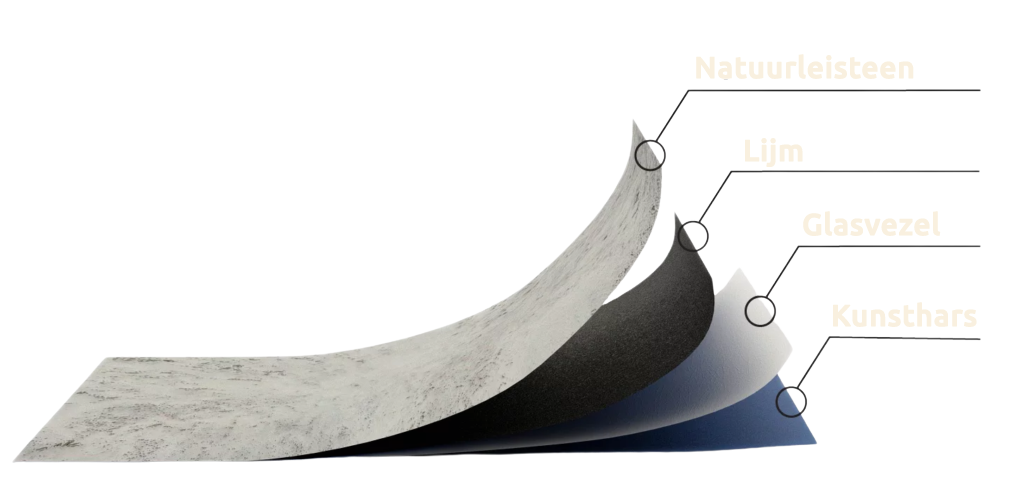
The production process consists of four key layers:

  • Natural slate – 100% real stone layer
  • Adhesive layer – bonds the stone with the fibre
  • Fiberglass – provides flexibility and strength
  • Epoxy resin – stabilises the structure and protects against water

How is the sheet created?
The slate block is heated and then coated with resin, adhesive and fiberglass. After cooling, the resin peels off a thin layer of stone, creating a finished veneer sheet.


3. Properties and technical parameters

  • Thickness: 2–3 mm
  • Weight: approx. 2.5 kg/m²
  • Flexibility: can be installed on arches and columns
  • Moisture resistance: very high
  • Thermal resistance: suitable for fireplaces
  • UV resistance: ideal for façades

Key features:

  • Natural, unique appearance
  • Lightweight and easy transport
  • Simple installation
  • Possibility of installation over existing tiles
  • Resistance to cracking and weather conditions

4. Applications of Stone in Roll – where does it work best?

Indoor applications:

  • Decorative walls (living room, TV wall)
  • Hallways and staircases
  • Bathrooms – including in the shower area
  • Kitchens – between worktop and cabinets
  • Fireplaces and stoves
  • Furniture, doors, kitchen islands

Outdoor applications:

  • Building façades
  • Fences and low walls
  • Terraces, entrances, vestibules
  • Outer cladding of balconies

5. Types of stone veneer – colours and structures

  • Slate: greys, blacks, graphite tones, browns
  • Quartzite: natural sheen, shimmering particles
  • Sandstone: beige, brown, yellow tones
  • Travertine: pronounced veining
  • Rustic slate: strong, intensive textures

6. Installation of Stone in Roll – practical guide

Tools needed:

  • Angle grinder with diamond blade
  • Pressure roller
  • Notched trowel
  • Polyurethane adhesive

STEP 1 – Surface preparation: clean, degreased, may be uneven; installation over tiles without removal.

STEP 2 – Cutting: angle grinder, saw or heavy-duty knife.

STEP 3 – Gluing: adhesive on the wall or on the veneer, spread with a trowel, press with a roller.

STEP 4 – Joints and wet areas: in dry areas joints are not necessary; in wet zones use silicone and impregnation.

STEP 5 – Impregnation: Fila MP90, Fila FOB, Stone Plus, Fila Satin – repeat every 6–12 months.

7. Comparison – Stone in Roll vs Natural Stone Tiles

Feature Stone in Roll Stone Tiles
Thickness 2–3 mm 10–20 mm
Weight approx. 2.5 kg/m² 25–50 kg/m²
Installation Fast, no joints required More difficult, requires joints
Flexibility Yes None
Transport Light and inexpensive Heavy and expensive

8. How to maintain Stone in Roll?

  • Clean with a soft cloth
  • Avoid strong detergents
  • Impregnate in wet zones 1–2 times per year
  • Do not hit the edges with sharp tools

9. Frequently Asked Questions (FAQ)

  • Is it waterproof? Yes, after impregnation.
  • Is it suitable for use in the shower? Yes.
  • Can it be used on a fireplace? Yes.
  • Can it be used on façades? Yes – with suitable exterior adhesive.
  • Can it be installed on old tiles? Yes.
  • Is it heavy? No.
  • Is it durable? Very – resistant to UV, water and mechanical damage.

10. How do we ship Stone in Roll?

Small formats are shipped flat, larger ones are rolled up and secured. The parcels are protected against damage and delivery usually takes a few working days.

Write a review

Please login or register to review